
Single-State with Nuclear-Weapon-Free Status and Third Generation Zones: Looking at the NWFZ Issue from a Broader Perspective
In this policy brief, Dr. J. Enkhsaikhan argues that the global Nuclear-Weapon-Free Zone (NWFZ) regime needs to expand horizontally to include non-committed individual states – such as landlocked states, neutral states, and small island states – that cannot join traditional, treaty-based regional zones. Drawing on Mongolia’s experience since 1992 as the only state to advocate for single-State zones, the author proposes creating “third-generation” (non-traditional) zones rooted in national legislation and linked to Nuclear-Weapon States (NWS) through agreed security understandings. Amid intensifying great-power rivalry, evolving deterrence doctrines, and technological risks, leaving non-committed states outside the regime creates blind spots, weakens the broader non-proliferation architecture, and exposes them to proxy dynamics or strategic targeting.
To make third-generation zones viable without undermining existing regional treaties, Dr. Enkhsaikhan outlines practical steps including adopting national legislation barring nuclear weapons or related deployment technology, establishing “softer and smarter” commitments from NWS to respect that legislation, and using UNODA to maintain a transparent register of arrangements. He also calls for an in-depth study, ideally commissioned from an experienced international think tank, to develop a flexible model law template, address risks of conventional facilities being used to optimise nuclear threats, and hold consultations with NWS. The resulting recommendations could then be shared with Member States and brought to relevant forums, such as a dedicated conference, a UNDC meeting, or the next NPT Review Conference.
About the Author
Dr J. Enkhsaikhan is an international lawyer and diplomat who has served at the Ministry of Foreign Affairs of Mongolia, representing his country in Austria and at the United Nations. He also served as the foreign policy and legal advisor to President P. Ochirbat, the first democratically elected President of Mongolia, and as Executive Secretary of the National Security Council of Mongolia when the State Great Hural (parliament) considered and adopted the country’s first concepts of national security and foreign policy in 1994. As the country’s Permanent Representative to the United Nations, Dr Enkhsaikhan served as the focal point in promoting Mongolia’s nuclear-weapon-free status.
Dr Enkhsaikhan has contributed many articles on international relations, non-proliferation, and regional security, and organised or participated in many regional meetings aimed at promoting peace, stability, international cooperation, environmental protection, and good governance. He is the Chairman of Blue Banner, a Mongolian NGO dedicated to promoting the goals of nuclear non-proliferation and Mongolia’s nuclear-weapon-free status. He was born in Mongolia in 1950 and has the title of Ambassador Extraordinary and Plenipotentiary of Mongolia.
The opinions articulated above represent the views of the authors and do not necessarily reflect the position of the Asia-Pacific Leadership Network or any of its members. The APLN website is a source of authoritative research and analysis and serves as a platform for debate and discussion among our senior network members, experts and practitioners, as well as the next generation of policymakers, analysts and advocates. Comments and responses can be emailed to apln@apln.network.
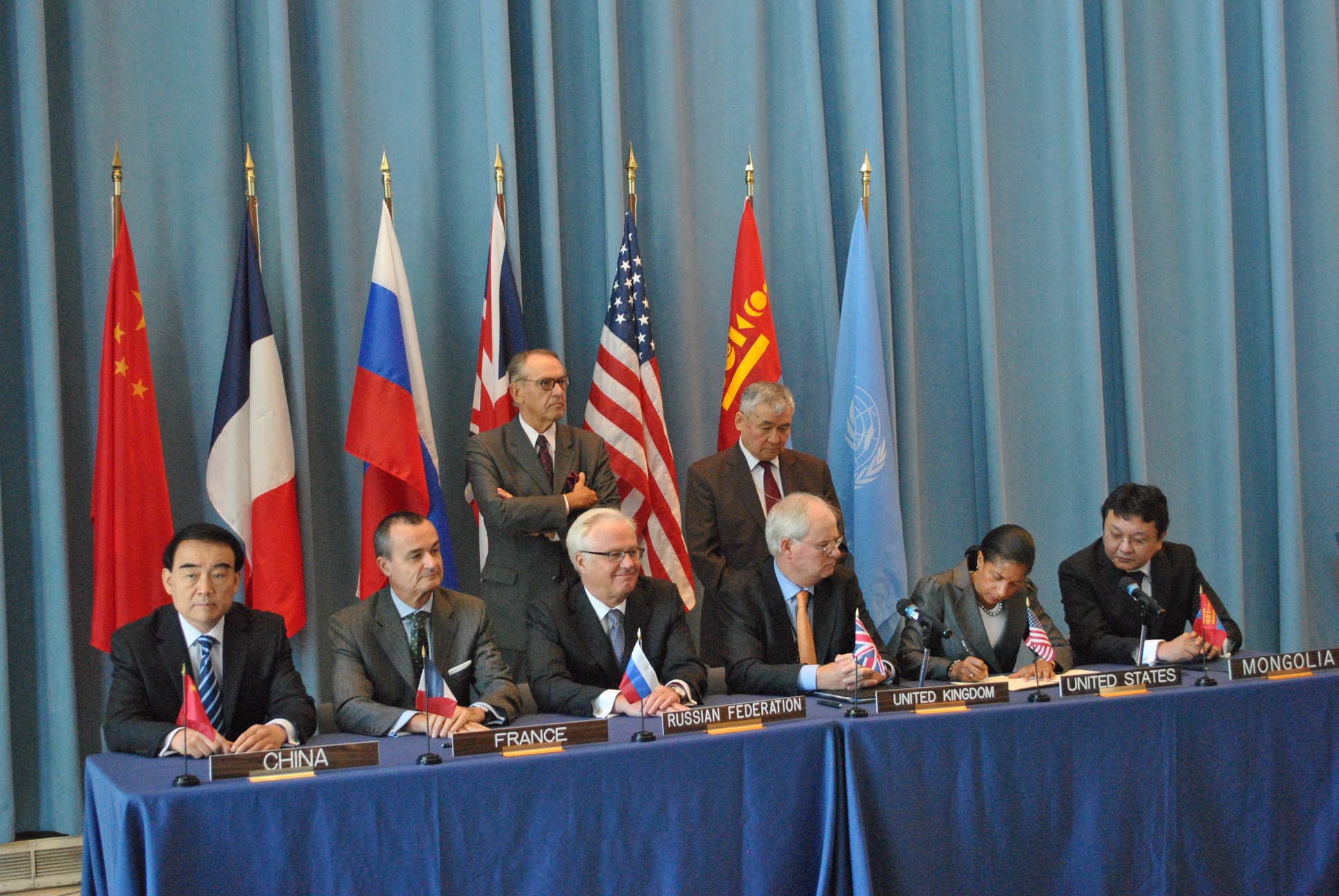
Image:The P5 signing the 2012 Joint Declaration and Mongolia is to sign a separate Declaration setting out its commitment. Image Courtesy: Blue Banner.


