
Funding Crisis Leaves UN Nuclear Watchdog Begging for Resources
The 180-plus members of the International Atomic Energy Agency (IAEA) are meeting this month in Vienna amidst an ongoing financial crisis. In June, IAEA Director General Rafael Grossi reported that if significant payments were not received soon, the agency would not be able to meet its legal obligations.
The cause? The failure of the wealthiest members to pay their assessed dues on time. Between them the United States and China account for 45% of the IAEA’s annual budget – roughly USD 250 million. Both have increasingly failed to make timely payments.
What’s at stake?
At risk are services vital to international peace and security.
The IAEA is best known for its nuclear safeguards system, underpinning the Nuclear Non-Proliferation Treaty (NPT). The key is on-site verification inspections and assessments of some 180 countries to confirm they are keeping their commitments not to acquire nuclear weapons. Some 800 highly trained IAEA inspectors conduct almost 3000 in-field verification activities each year.
A major focus of safeguards attention has been Iran’s nuclear activities. The bombing of Iran’s facilities in June 2025 forced IAEA inspectors to leave the country. Nevertheless, safeguards inspections continue at the Russian-supplied Bushehr nuclear power plant, and inspectors remain ready to return to other facilities as soon as conditions allow.
Other vital responsibilities of the IAEA include the promotion of a strong global framework for nuclear safety and nuclear security.
Since the Chernobyl disaster, the international community has recognised that nuclear safety is a global challenge that requires international tools — many of which are provided by the IAEA. Since the start of the war in Ukraine, IAEA staff have been stationed at the Zaporizhzhia nuclear power plant under conditions of great risk, producing over 360 public reports on developments there.
And in our immediate region, the IAEA has actively monitored the discharge into the sea of the water used to cool the Fukushima reactors damaged in the 2011 tragedy, confirming that these discharges remain well below regulatory and operational limits.
Beyond its regulatory and standard-setting roles, the IAEA helps developing countries harness nuclear technologies for national development — especially in medicine but also in agriculture and industry.
Restraint at any cost
The funding of international organisations has long been a contentious issue. From the 1960s, a shadowy alliance of the major (Western) contributors known as the Geneva Group consulted to restrain the costs associated with the rapid expansion of membership in these organisations.
In the 1980s, the Geneva Group started to impose a policy of “zero real growth” in the United Nations system, regardless of their roles and relative importance. This later evolved into a policy of “zero nominal growth,” effectively requiring budgets to be cut each year to offset inflation.
Consequently, funds were being cut just as demands for services were increasing, driven by the growth in IAEA membership and the emergence of new and increasingly complex, resource-intensive inspection challenges, such as the inspections in Iraq and the safeguarding of Iran’s nuclear programme.
To meet these demands, the IAEA increased its reliance on voluntary contributions. For some governments, the insistence on reduced budgets was a policy pursued regardless of the real costs involved: where they considered particular programmes vital, they would provide voluntary payments outside the regular budget, known as “extrabudgetary funding”. The United States has long been a major contributor of extrabudgetary funding, and China has also become a significant player.
Extrabudgetary funding requires careful management lest it distorts the balance of interests among IAEA member states. It can also dilute the neutral international character of the IAEA’s activities and risk giving funding providers disproportionate influence over the organisation’s priorities and activities.
Keeping the nuclear watchdog fit for purpose
A first and immediate step is for the major contributors to resume making full and timely payments. Their current delays amount to bullying behaviour and risk unduly influencing the IAEA’s programs and priorities.
The only sanction against non-payment is the provision in the IAEA statutes that members more than two years in arrears will lose their right to vote in the IAEA’s governing bodies. To date, this provision has been sufficient to deter prolonged financial default. But financial uncertainty carries its own cost, including the cost of rescheduling planned activities, or, in some cases, not delivering them at all.
Other significant contributors including those in our region — Japan, Korea and Australia — pay their contributions in full and on time, only to see their good international citizenship exploited by the two dominant players.
The Asia-Pacific is now the leading region in global nuclear affairs and should therefore take a lead in calling for a return to full and timely payments to the IAEA.
More broadly, it is time to reconsider the role of the Geneva Group. Zero-growth policies were blunt instruments which achieved a very limited purpose. A more nuanced approach is needed, one that allows differentiation among agencies as they evolve to meet changing global challenges and respond to the changing expectations and needs of the international community.
Over its 70 years of history, the IAEA has earned an enviable record as the world’s highly professional and respected nuclear watchdog. It has also proven its capacity to adapt to new demands, from the challenges posed by would-be nuclear proliferators to those arising from nuclear safety and security.
It is in our collective interests to ensure that the IAEA’s funding needs are assessed on their merits and that all its members meet their fair share of the costs in full and on time.
About the Authors
John Carlson is APLN senior associate fellow. He is also a nonresident senior fellow at the Vienna Center for Disarmament and Non Proliferation and a member of the International Advisory Council to the International Luxembourg Forum.
John Tilemann is APLN senior associate fellow. He was Australia’s deputy permanent representative to the International Atomic Energy Agency (IAEA) and was subsequently seconded as chief of staff to IAEA Director Generals Dr Hans Blix and Dr Mohamed ElBaradei. He served as Australia’s ambassador to Jordan 2002-2006 and previously was posted in Thailand, Sri Lanka, Pakistan, and Poland.
Disclaimer: The opinions articulated above represent the views of the author(s) and do not necessarily reflect the position of the Asia-Pacific Leadership Network or any of its members. APLN’s website is a source of authoritative research and analysis and serves as a platform for debate and discussion among our senior network members, experts, and practitioners, as well as the next generation of policymakers, analysts, and advocates. Comments and responses can be emailed to apln@apln.network.
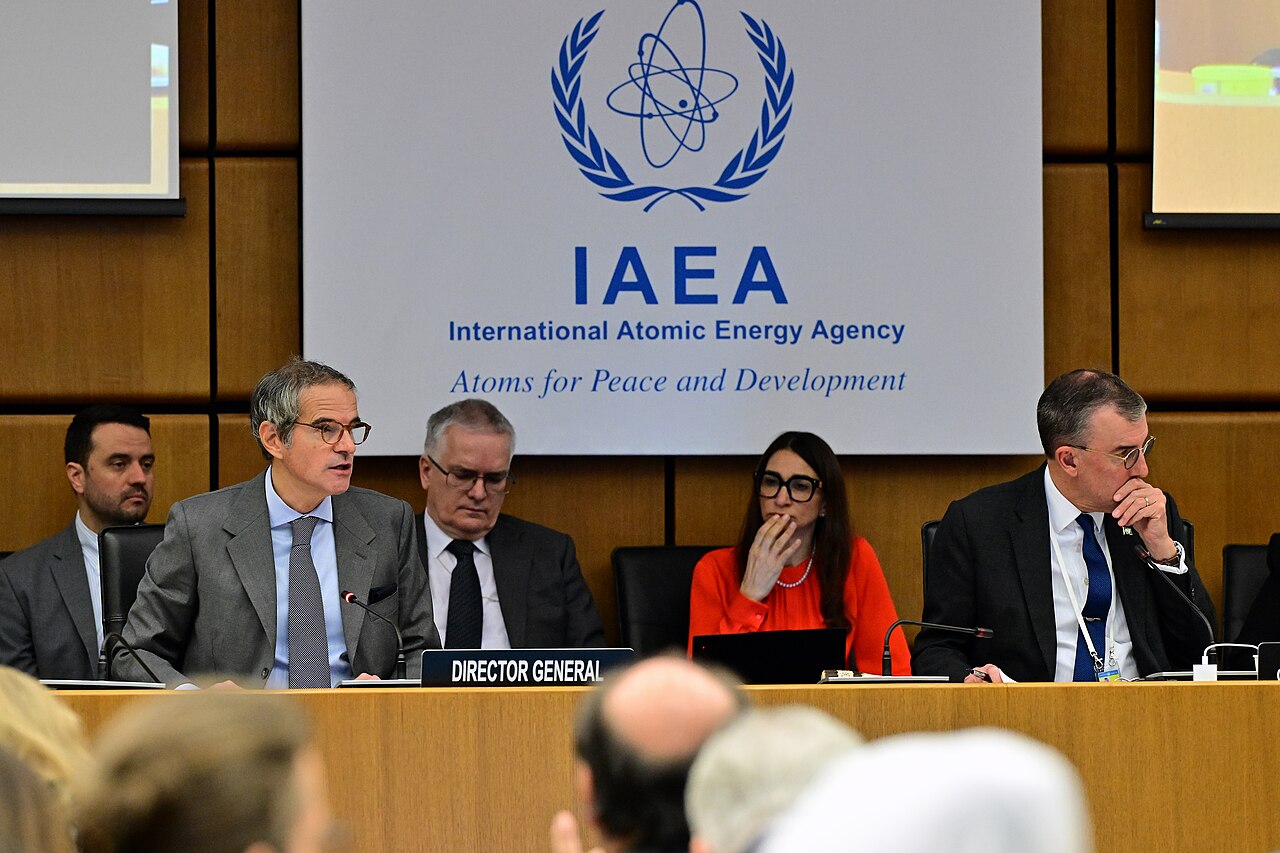
Image: Rafael Mariano Grossi, IAEA Director General, delivers his statement at the opening of the 1795th Board of Governors meeting held at the Agency headquarters in Vienna, Austria. 2 March 2026. Dean Calma / IAEA. Wikimedia Commons.
_(55124307076).jpg)
This article was originally published in The Korea Times on 9 September 2026 here and was subsequently republished by Pearls and Irritations here.