
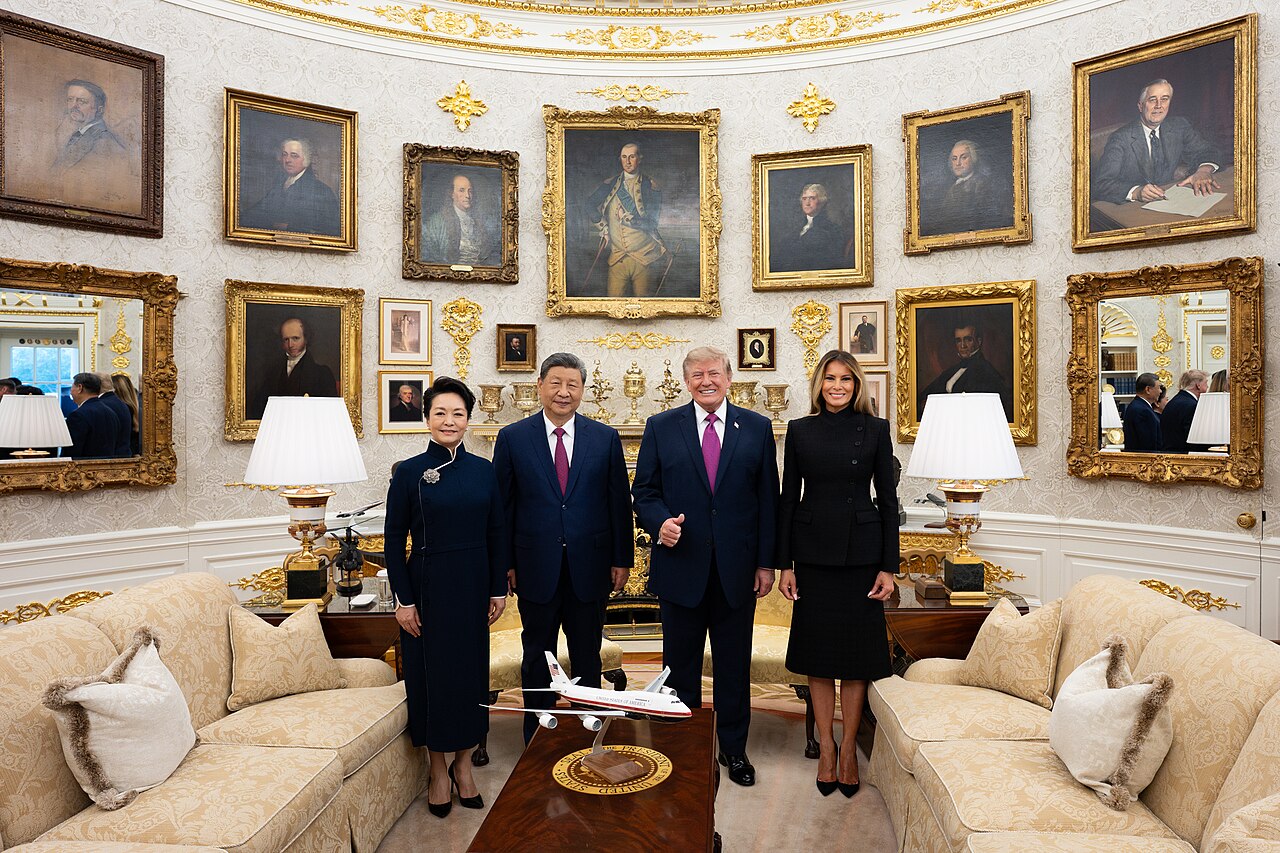
Trump-Xi Summit Diplomacy
Following the 24 September 2026 summit meeting between President Xi Jinping and President Donald Trump in Washington DC, leading analysts Jiang Tianjiao, Andrew Yeo and Kristy Hsu weigh in on whether the two powers can transform high-level dialogue into a “constructive relationship” and what concrete steps are required to get there. Read their insights in our latest Pulse series on the Trump-Xi summit diplomacy.
Jiang TianjiaoAssociate Professor at Development Institute of Fudan UniversityA confident Beijing seeks to institutionalise multi-sector dialogue with Washington to manage competition.
Since President Trump’s visit to Beijing in May, China and the United States have been building a constructive strategic stability relationship. President Xi’s return visit to Washington has further deepened cooperation within this framework. Going forward, both sides need to translate the consensus reached by the two heads of state into institutional mechanisms, including establishing multi-level dialogue channels in areas such as trade and economics, artificial intelligence, military-to-military relations, and people-to-people exchanges. At the same time, both sides should properly manage differences and safeguard peace and stability across the Taiwan Strait.
Through leader-level diplomacy and the establishment of mechanisms across multiple sectors, the summit has demonstrated that a more confident China may be more willing to accept bounded and benign competition while exercising strategic restraint toward the United States. This confidence stems in part from Beijing’s assessment that the trade and technology wars over the past eight years have not stifled China’s development; rather, they have catalysed major breakthroughs across multiple sectors and bolstered its international influence. Nevertheless, by proactively proposing a constructive strategic stability relationship with the United States, China seeks to manage differences and prevent vicious competition or even crisis escalation through extensive dialogue and cooperation.
Andrew YeoSenior Fellow and the SK-Korea Foundation Chair at the Brookings Institution’s Center for Asia Policy StudiesWashington must combine managed competition with China and meaningful consultation with Asia-Pacific allies.
US allies and partners in the Asia-Pacific want to avoid a confrontation with China that escalates into conflict and destabilises the entire region. They therefore welcome a credible framework for strategic stability and managed competition between the United States and China, as articulated by Beijing. However, they fear that “stability” might become a euphemism for Washington accommodating Beijing at their expense.
Restoring allied confidence needs more than just exchanging diplomatic pleasantries between President Xi and President Trump. Allies and partners will watch whether Washington engages Beijing without ignoring their legitimate security and economic concerns – such as China’s encroachment in the South China Sea, its coercive activities within the first island chain including the Taiwan Strait, and Beijing’s economic aggression toward regional actors. Any bilateral bargain reached without meaningful consultation with allies will only erode trust in the credibility and durability of US leadership.
Regional partners need the United States to uphold a rules-based order that resists unilateral change to the status quo. The Trump administration’s repeated oscillation between accommodation of and confrontation with Beijing leaves allies unable to anticipate the direction of US–China competition. Therefore, to truly reassure its partners and allies of its role in the Asia-Pacific, Washington must use such summits to establish clear guardrails while reaffirming alliance commitments.
Kristy HsuDirector, Taiwan ASEAN Studies Center, Chung Hua Institution for Economic Research (CIER)US-China stability requires shifting from temporary truces to institutionalised diplomacy that protects Taiwan.
The September Trump–Xi meeting suggests that Washington and Beijing are moving toward a limited framework of managed strategic competition rather than genuine strategic accommodation. Building on the “constructive relationship of strategic stability,” outlined at the May summit, the recent Washington discussions reinforced both leaders’ preference for continued dialogue and bounded competition. Yet the outcome remains modest: the trade truce was extended by only two months, while core disputes over technology, security, and Taiwan remain unresolved. Establishing a durable framework will require institutionalised high-level dialogue, military crisis-management mechanisms, more predictable economic and technology rules, and mutual restraint against unilateral changes to the status quo.
Such arrangements are unlikely to be fully established by the upcoming Trump–Xi summit later this year. The more immediate question, however, is whether the next meeting can demonstrate continuity and begin translating the understandings reached in May and September 2026 into institutionalised processes. Until that structure is put in place, the durability and true strategic significance of the progress achieved at the two summits will remain uncertain.
From Taipei’s perspective, the central concern is whether strategic stabilisation will become a transactional agreement. President Xi again pressed Washington to “oppose Taiwan independence” and handle Taiwan with “prudence,” but there is no reported indication that the United States has adopted this stronger formulation or altered its long-standing position. Meanwhile, Washington’s security cooperation and arms-sale commitments to Taiwan have continued, suggesting that Washington’s engagement with Beijing and support for Taiwan need not be mutually exclusive: high-level dialogue can provide reassurance and facilitate crisis management, while Taiwan’s strengthened self-defence maintains deterrence.
The pending US$14 billion arms package, however, illustrates the ambiguity embedded in this approach. After the May 2026 summit, President Trump acknowledged that the arms package To Taiwan had been held in abeyance and described the arms sales as a negotiating instrument; as of the September 2026 meeting, the package remained under presidential review.
While Taiwan’s Ministry of National Defense has stated remaining in close communication with Washington to ensure that the agreed arms sales proceed as planned, prolonged linkage between Washington’s arms decisions and negotiations with Beijing could risk creating transactional ambiguity. If Beijing perceives that pressure over Taiwan can generate concessions elsewhere, deterrence could be weakened, incentivising Beijing’s coercive diplomacy.
A potential Trump–Xi meeting at the APEC Leaders’ Meeting in Shenzhen in November 2026 could serve as a critical test of whether the Trump-Xi summits truly represent an institutionalised process or merely a one-off political bargain. If such a meeting in fact occurs, the key indicators will be whether the two sides can move beyond short-term extensions towards more durable arrangements on trade and critical supply chains, and whether Taiwan-related issues remain institutionally separate from economic bargaining.
The opinions articulated above represent the views of the author(s) and do not necessarily reflect the position of the Asia-Pacific Leadership Network or any of its members. APLN’s website is a source of authoritative research and analysis and serves as a platform for debate and discussion among our senior network members, experts, and practitioners, as well as the next generation of policymakers, analysts, and advocates.
Comments and responses can be emailed to apln@apln.network.
Image: US President Donald Trump, First Lady Melania Trump and CCP General Secretary and Chinese President Xi Jinping, First Lady Peng Liyuan tour the Smithsonian National Museum of Asian Art in Washington, D.C., Thursday, September 24, 2026. (Official White House Photo by Andrea Hanks) Wikimedia Commons.


.jpg)