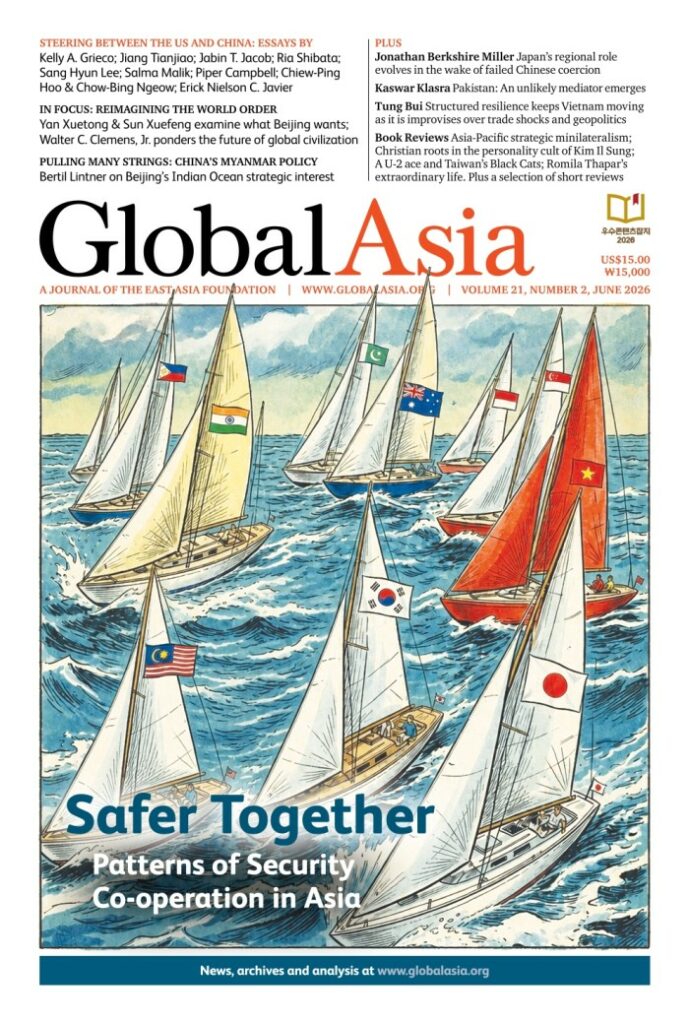
Safer Together: Patterns of Security Co-operation in Asia
The June 2026 special issue of the Global Asia journal features nine short essays from APLN’s Asia Dialogue on China-US Relations. The essays are drawn from longer research papers and remarks presented at APLN’s 2026 Asia Dialogue on “The Shifting Trajectories of Security Cooperation in the Asia-Pacific” held in Kuala Lumpur, Malaysia in April 2026. The dialogue brought together leading experts and former practitioners from the United States, China, and from across the Asia-Pacific region.
Global Asia is a quarterly publication of the East Asia Foundation. The nine essays from the June 2026 special issue form part of an up-to-date analytical and policy compendium examining how the strategic policies of states in the Asia-Pacific are evolving amid geopolitical competition and contestation, and how regional states in the Asia-Pacific are recalibrating their defence and security partnerships with each other and with the United States and China.
“In Kuala Lumpur on April 28-29, Global Asia joined a workshop organized by the Asia-Pacific Leadership Network (APLN), with the support of the Carnegie Corporation of New York, to discuss the changing course of security co-operation in Asia. Leading academics, former diplomats and military leaders engaged in a lively and at times blunt exchange of views on the challenges that lie ahead. The nine essays in this cover package of Global Asia are some of the fruits of that exchange. For countries in Asia, the US-China rivalry isn’t a spectator sport. Leaders in the region are actively seeking to influence the outcome of the game, as these essays illustrate.”
Letter to Readers, Global Asia, June 2026, Vol.21 No.2
The following essays are featured in the Global Asia June 2026 (Vol.21 No.2) special issue. Read the full issue here.
- In an Age of Flux, Asia’s Circles of Friends Are Expanding by Kelly A. Grieco
Regional countries have developed a complex mechanism of ‘minilateral’ arrangements to navigate between the US and China, but those arrangements need nurturing. - China Looks to the SCO and BRICS as Key Tools of a Changing Order by Jiang Tianjiao
China backs multilateral institutions now emerging as key players in a transforming international order. - How China Uses Discourse to Erode US Dominance by Jabin T. Jacob
Beijing is accelerating its narrative-building, notably directed at its Asian neighbors who have been loath to choose sides. - Japan’s Middle-Power Ambitions and the Weight of History by Ria Shibata
Chinese pressure on leader Sanae Takaichi backfired and enabled a more assertive defense posture, but Japan’s middle-power ambitions are constrained by larger questions. - South Korea’s Pragmatic, Principled, Prudent Path Between the US and China by Sang Hyun lee
Reliant on both in different ways, South Korea needs a wise combination of approaches. - Multilaterals and Minilaterals in the Asia-Pacific: A View from Pakistan by Salma Malik
As China aids Global South aspirations, Islamabad is eying alternatives to a West-led order in disarray. - ASEAN Must Get Its House in Order by Piper Campbell
Southeast Asian nations must pull together better and burnish ASEAN’s reputation as an economic power amid China-US rivalry. - Malaysia’s Defense Partnerships in an Era of Strategic Uncertainty by Chiew-Ping Hoo & Chow-Bing Ngeow
Those partnerships require delicacy, but they help ensure security for Malaysia and Southeast Asia without a need to choose sides. - The Philippines Must Learn to Protect Itself by Erick Nielson C. Javier
Uncertain of its US alliance, it is modernizing its military and upgrading its defense doctrine. This must continue.