Southeast Asia Multialignment Agency and Hedging Bets Beyond US-China Flux
In recent years, Southeast Asia has emerged as a key region where an intensifying US-China competition intersects with efforts to exercise agency. While facing intense structural pressures, regional actors are actively trying to reshape their relationships with both powers and their wider alignments. This intersection has potentially profound implications given Southeast Asia’s significance as the world’s fifth-largest economy; third-most populous actor; leading hub for critical sea lanes including the Malacca Straits and the South China Sea; and the main Indo-Pacific diplomatic convenor via the Association of Southeast Asian Nations (ASEAN). As such, the alignment decisions of key regional states could affect a range of areas in the coming years. These include the geoeconomic trajectories of supply chains in sectors such as critical minerals or semiconductors, and the balance of US-China military power as it pertains to Taiwan and other potential regional flashpoints.
This policy brief explores Southeast Asia’s specific approach to shifting alignments amid structural US-China competition and wider regional and global challenges. It is informed by conversations with policymakers from all eleven countries in Southeast Asia as well as field research trips to key Indo-Pacific capitals.
The brief makes three main arguments. First, evolving geopolitical and geoeconomic dynamics are already affecting the relationships of Southeast Asian states across all five levels of alignments, namely the intrastate; interagency; interstate, interregional and intercontinental levels. Second, Southeast Asian states are adopting four different pathways for multialignments – which include groupings that feature the United States and/or China as members – represented in a “4R” framework: renegotiation; recalibration; reinforcement; and renovation. These pathways allow them to adapt their approaches to the United States and China; diversify their ties with a wider array of partners; and shape their domestic and global environment within existing constraints. Finally, Southeast Asian states can take steps on their own and with their partners to better navigate alignment dynamics across the DIME model of diplomatic, informational, military and economic policies. These actions can reinforce Southeast Asia’s role as a global multialignment testbed in its own right, rather than simply being a China-US battleground.
About the Author
Dr. Prashanth Parameswaran is a senior fellow at the Foreign Policy Research Institute and the founder of the weekly ASEAN Wonk newsletter on Southeast Asia and Indo-Pacific geopolitics and geoeconomics. Born and raised in Southeast Asia, he is also a senior columnist at The Diplomat, an advisor at the strategic consultancy BowerGroupAsia, a fellow at the Institute for Indo-Pacific Security, and a course instructor at the State Department and the Pentagon. He has spent nearly two decades working with businesses, think tanks, governments and universities on Southeast Asia and the Indo-Pacific region, including early stints with Singapore’s Ministry of Trade and Industry, the Agence France-Presse news wire service agency in Thailand and the Center for Strategic and International Studies in Washington, D.C. He has conducted extensive field research across the Indo-Pacific region including all 11 countries in Southeast Asia, publishing over 2,000 articles and commentaries including in international outlets like CNN, The Straits Times, Nikkei Asia, South China Morning Post and Foreign Policy on topics such as major power competition, maritime security, economic statecraft, regional institutional development, military modernization and foreign policy strategy. He is the author of two books: Mandalas of Multialignment: Hedging Bets in Southeast Asia Grand Strategy Spheres, Foreign and Security Policy Webs, and Global Geopolitics and Geoeconomics (2026) and Elusive Balances: Shaping US-Southeast Asia Strategy (2022). He holds a Ph.D. and an MA from the Fletcher School of Law and Diplomacy at Tufts University and a BA with highest honors from the University of Virginia.
This essay is published as a part of APLN’s Asia Dialogue on China-US Relations, supported by a grant from the Andrew Carnegie Foundation (formerly known as Carnegie Corporation of New York). The views represented herein are the authors’ own and do not necessarily reflect the views of affiliated institution(s), nor that of APLN, its staff, members, board, or funders. APLN’s website is a source of authoritative research and analysis and serves as a platform for debate and discussion among our senior network members, experts, and practitioners, as well as the next generation of policymakers, analysts, and advocates. Comments and responses can be emailed to apln@apln.network.
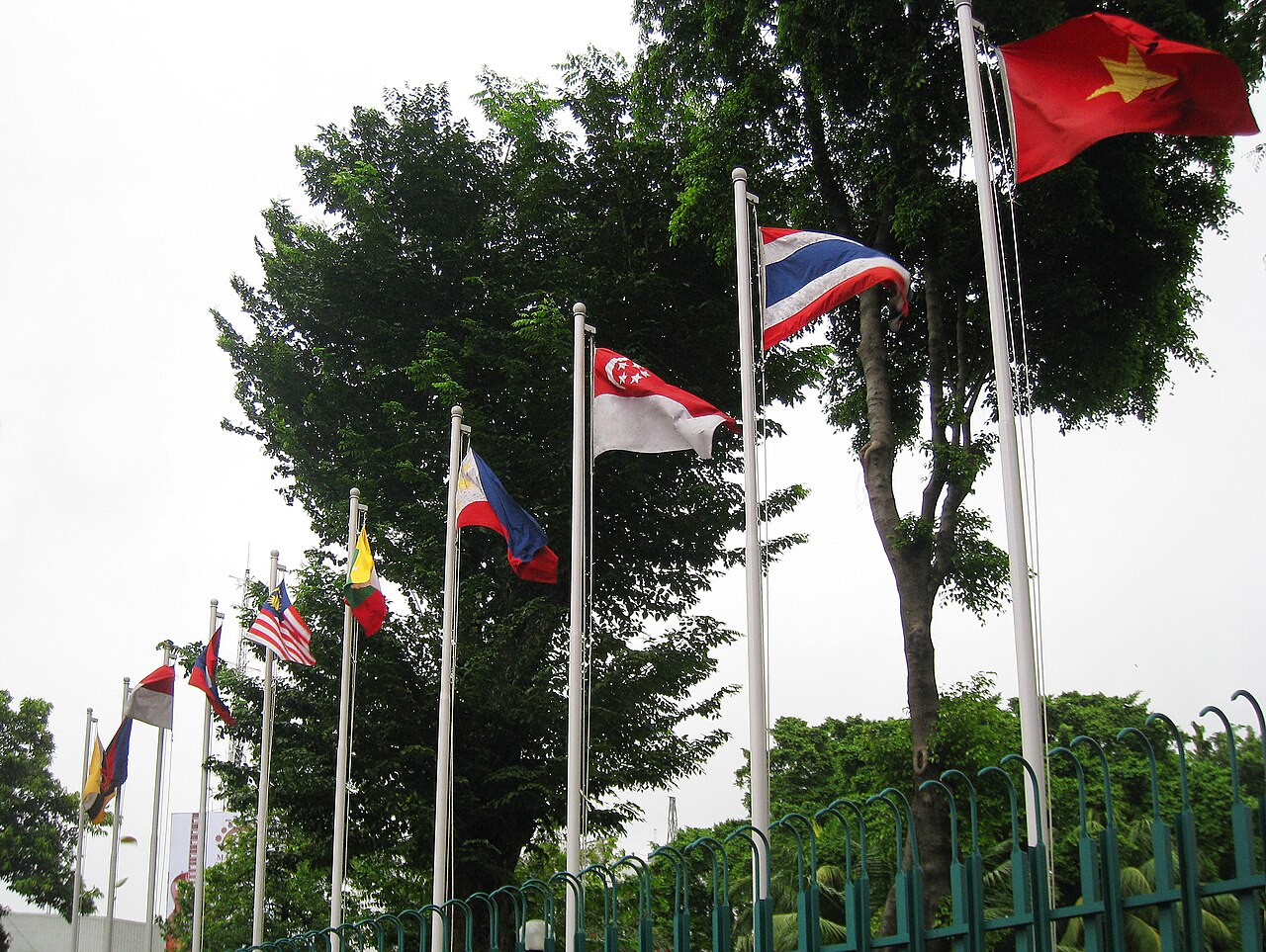
Cover image: The flags of Association of Southeast Asia Nations (ASEAN) members at the ASEAN headquarter in Indonesia. Wikimedia Commons/Gunawan Kartapranata.