Nuclear Fail-Safe Reviews: Relevant Issues from US Government Accountability Office Reports
Nuclear “fail-safe” reviews consist of internal national reviews of the safeguards of nuclear forces and supporting systems against unauthorised, accidental and mistaken nuclear use. As emerging technologies – including AI, quantum, cyber, and space systems – become more prominent as threats to nuclear forces and in potentially influencing decision-making, these internal reviews can surface new and emergent nuclear vulnerabilities for policymakers to address.
APLN’s ongoing activities regarding potential fail-safe reviews in Asia-Pacific nuclear-armed states have included multiple workshops with Chinese, Indian, and Pakistani interlocutors, commissioned research from national experts, and co-sponsorship of a February 2026 Munich Security Conference joint statement alongside the Euro-Atlantic Security Leadership Group (EASLG), European Leadership Network (ELN), the Grandview Institution, and the Nuclear Threat Initiative (NTI).
As states consider how to design and implement fail-safe reviews, the types of issues which reviews might anticipate, identify, and address have been a common point of discussion across APLN’s regional engagements.
The report from the 1990-92 US fail-safe review is the only one to be even partly declassified. The findings of the most recent 2022-2024 US nuclear fail-safe review, mandated by the US Congress in 2021, remain classified. However, the US Government Accountability Office (GAO) conducts US Government financial and performance audits on behalf of the US Congress, including on classified and sensitive national security institutions and processes. Importantly, it publishes the titles of classified and sensitive (“controlled unclassified”) reports on a publicly available “Restricted Reports” page on its website, making this information accessible to all.
To assist Asia-Pacific nuclear-armed states in understanding the political, technical, and bureaucratic issues that a rigorous fail-safe review might surface and address, this policy brief reproduces select report titles from this publicly available GAO Restricted Reports webpage. National nuclear forces will naturally differ in their composition, bureaucratic organisation, and challenges relevant to fail-safe concerns. This list should accordingly not be interpreted as a complete or prescriptive set of issues which all nuclear-armed states should investigate as part of a fail-safe review. Instead, it is merely a guide to some issues with potential fail-safe significance that the United States, as one contemporary nuclear-armed state, is engaging with or has recently engaged with.
We intend this policy brief to be a resource for regional state nuclear decision-makers and policy communities, in illustrating the types of issues and broader themes which a fail-safe review might surface.
About the Author
Dr. Frank O’Donnell is Research Program Head at the Asia-Pacific Leadership Network, and an Adjunct Fellow at the East-West Center. With a particular specialty on Southern Asia, his areas of expertise include nuclear and conventional military posturing, arms control, non-proliferation, and national security policymaking processes. He was previously Deputy Director and Fellow at the Stimson Center South Asia Program, and has held postdoctoral research roles at the Fletcher School and US Naval War College. He has been a Stanton Junior Faculty Fellow and Associate at the Belfer Center for Science and International Affairs at Harvard University, an Assistant Professor (UK: Lecturer) at the Britannia Royal Naval College, and has held additional research positions at the University of Aberdeen and James Martin Center for Nonproliferation Studies.
This publication was made possible by a grant from Longview Philanthropy.
The opinions articulated above represent the views of the author and do not necessarily reflect the position of the Asia-Pacific Leadership Network (APLN) or any of its members. The APLN website is a source of authoritative research and analysis and serves as a platform for debate and discussion among our senior network members, experts and practitioners, as well as the next generation of policymakers, analysts and advocates. Comments and responses can be emailed to apln@apln.network.
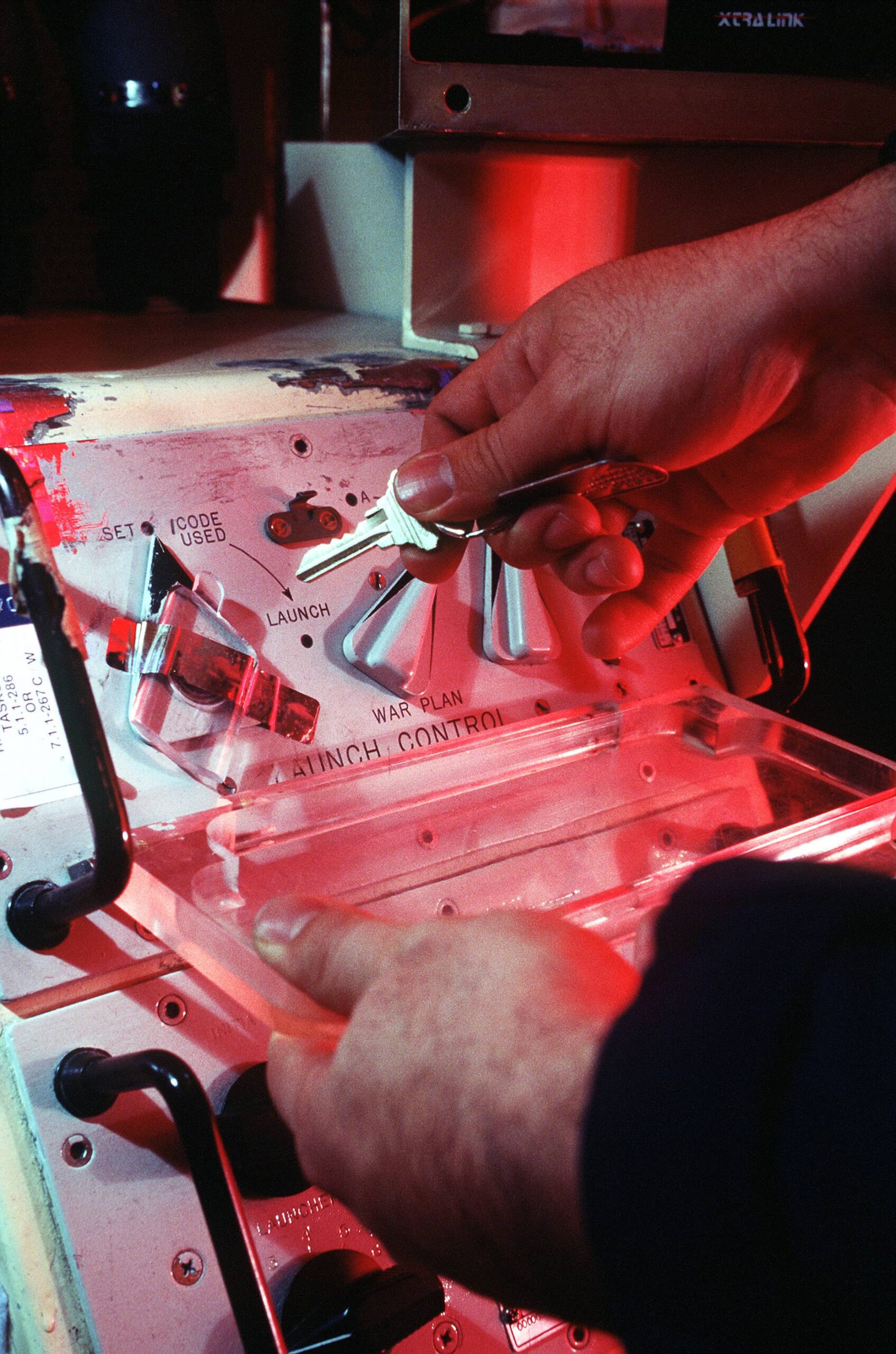
Image: ‘In a simulation of a Peacekeeper Missile Launch, two Launch Keys similar to the one pictured here, are inserted into the Launch Control Panel by both Crew Commander and Deputy Crew Commander which must be turned simultaneously to activate the launch’, National Archives Catalog, https://catalog.archives.gov/id/6499549