Institutional cooperation between NATO and IP4: Expectations, constraints, and cooperation prospects
This report draws on discussions among an international working group convened by the European Leadership Network (ELN) and the Asia-Pacific Leadership Network (APLN). The following experts contributed to the development of the report and endorse it in their personal capacities: Professor David Capie (Chair), Mr. Flynn Acworth, Professor Stephan Frühling, Ms. Mirna Galic, Dr. Gorana Grgić, Ambassador Masafumi Ishii, Dr. Saeme Kim, Dr. Julia Macdonald, Dr. Oliver Meier, Dr. Frank O’Donnell, Mr. Joel Petersson-Ivre, Ms. Shatabhisha Shetty, and Mr. Piotr Szymański.
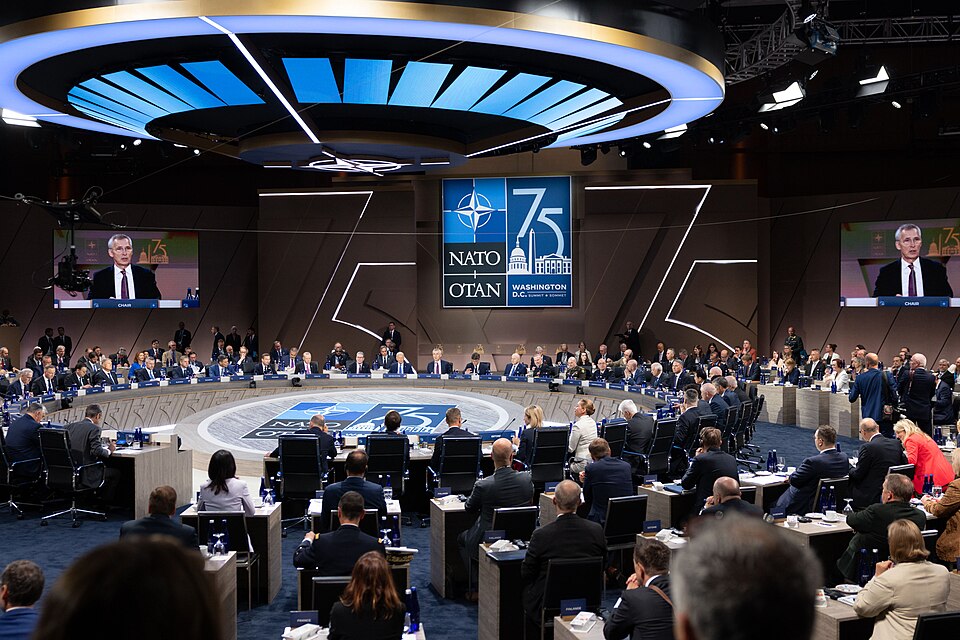
The relationship between NATO and its four Indo-Pacific partners – Australia, Japan, New Zealand, and the Republic of Korea (ROK), collectively known as the Indo-Pacific 4 (IP4) – has deepened considerably in recent years. Their growing alignment reflects a shared recognition that developments in the Euro-Atlantic and Indo-Pacific increasingly affect security in both regions.
But the partnership is facing significant constraints. Diverging perceptions of China, North Korea, and Russia, limited resources and capacity, and uncertainty surrounding the trajectory of US grand strategy are restricting the scope for deeper cooperation under a formal NATO-IP4 framework.
Drawing on discussions among senior Track-II experts from the Euro-Atlantic and Indo-Pacific, this report assesses where institutional cooperation can make a practical contribution. It finds that NATO and the IP4 can strengthen crisis prevention through better information-sharing, sustained exercises, political coordination, and working-level integration. Their capacity to manage an active crisis in the other region, however, remains severely limited.
The report argues that NATO and the IP4 should focus on practical, flexible cooperation without creating a rigid institutional structure.
Rather than building new institutional structures, the report recommends strengthening the foundations of cooperation that already exist. This includes improving information-sharing and strategic assessments, expanding military exercises and interoperability, developing coordinated approaches to strategic communications and crisis response, and deepening working-level engagement between NATO and IP4 partners. It also argues that flexible, project-based cooperation and stronger political relationships can enhance crisis prevention while preserving the adaptability of the partnership. Detailed policy recommendations are available in the full report.
This report was produced by a working group convened by the European Leadership Network and the Asia-Pacific Leadership Network. It was sponsored by the NATO Science for Peace and Security Programme under grant SPS.MYP.G7935. The views expressed are those of the authors and do not necessarily reflect the position of NATO, the European Leadership Network, the Asia-Pacific Leadership Network, or the other institutions mentioned in the report. The ELN aims to encourage debates that will help develop Europe’s capacity to address the pressing foreign, defence, and security policy challenges of our time, in furtherance of its charitable purposes.